Less logging. More useful context.
Track your food from one photo.
Let SAGEViBE turn a quick photo into nutrition context you can actually use.
What is an emotion wheel?
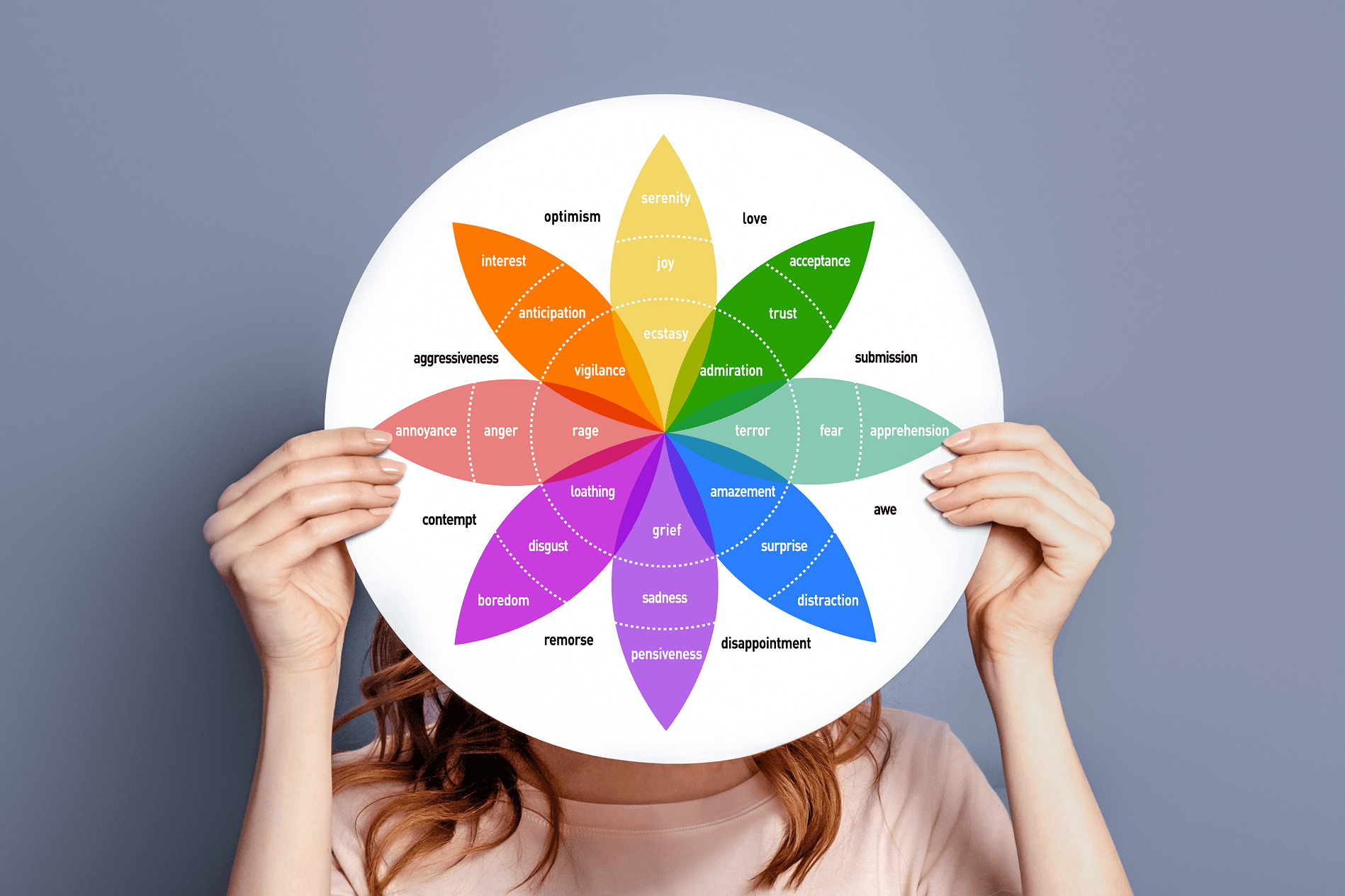
An emotion wheel is a diagram that organizes emotions by similarity and intensity so a feeling is easier to locate and name. Instead of choosing between "good" and "bad," you find your feeling among dozens of specific words arranged in a pattern. That single act — putting a precise name to a vague state — is the whole point, and it's why emotion wheels show up in therapy rooms, classrooms, and mood apps alike.
There are two families of emotion wheel worth knowing. They come from different scientists and answer slightly different questions.
Plutchik's wheel of emotions: the eight core emotions
Robert Plutchik's wheel (1980) is built on eight core emotions arranged as four opposite pairs: joy vs sadness, trust vs disgust, fear vs anger, and surprise vs anticipation. Each emotion appears at three intensities — so anger runs from mild annoyance to anger to intense rage, and the colors deepen toward the center as intensity rises.
Plutchik's model adds one more idea that makes it feel true to life: adjacent emotions blend into more complex ones. Joy plus trust makes love. Anticipation plus joy makes optimism. Fear plus surprise makes alarm. This is the "rich, grown-up" map — good for people who want vocabulary for subtle, mixed feelings.
- Strength: nuance and depth; a large, expressive vocabulary.
- Trade-off: more to take in — harder to answer in one tap when you feel low.
What is the Mood Meter (the circumplex model)?
The Mood Meter is a four-quadrant grid based on the circumplex model of affect (Russell, 1980): every feeling is placed by two questions — how much energy (high or low) and how pleasant (unpleasant or pleasant) it is. Those two axes create four colored quadrants:
| Quadrant | Energy × Pleasantness | Example feelings |
|---|---|---|
| Red | High energy, unpleasant | angry, anxious, frustrated |
| Yellow | High energy, pleasant | excited, happy, energized |
| Blue | Low energy, unpleasant | sad, tired, discouraged |
| Green | Low energy, pleasant | calm, content, relaxed |
This is the version psychologist Marc Brackett built into RULER, an emotional-literacy approach now used in thousands of schools, and into the "How We Feel" app. It's the most evidence-backed emotion wheel as a product precisely because it's so easy to act on: you don't need the perfect word first, you just tap where you are on the grid, then narrow down.
- Strength: fast, low-effort, action-friendly — ideal for a daily check-in.
- Trade-off: less nuance than Plutchik until you drill into a quadrant.
Plutchik vs the Mood Meter: which should you use?
Use the Mood Meter when you want a fast, in-the-moment read, and Plutchik when you want to explore a feeling in depth. They aren't rivals — they answer different questions. The Mood Meter asks "where are you right now?" in one tap; Plutchik asks "what exactly is this, and what is it made of?"
The most usable design borrows from both: the two-axis simplicity of the Mood Meter to get you in, and Plutchik's intensity and blends to give the feeling a precise name once you're there.
Why does naming an emotion on a wheel help?
Naming a feeling in specific terms is linked to handling it better — an idea researchers call emotional granularity. People who can tell "discouraged" apart from "drained" apart from "lonely" tend to respond to each more skillfully than people who only register "bad" (Barrett and colleagues). A wheel is simply the scaffolding that makes those finer words reachable.
One honest caveat: reflection helps, but brooding — circling the same negative thought without moving — can make a low mood worse (Nolen-Hoeksema, Wisco & Lyubomirsky, 2008). The goal of a good check-in is to name the feeling and feel witnessed, not to dig endlessly. That distinction shapes how we built ours. (SAGEVibe is a wellness companion, not a medical device — an emotion wheel supports self-awareness, it doesn't diagnose or treat anything.)
How SAGEVibe uses the emotion wheel
SAGEVibe folds the emotion wheel into a gentle daily check-in inside the chat, not a separate clinical form. The companion asks how you're feeling, what your energy is like, and what you notice in your body — and turns your answer into a simple colored indicator you can watch change over time.
- The check-in is short and low-pressure — the Mood Meter's "tap where you are," with Plutchik's richer vocabulary underneath for when you want it.
- It's asked once a day at most, in the moment, so the data reflects how you actually feel rather than how you remember feeling.
- Every check-in closes with support — you're never left alone with a hard feeling. On a low day, being witnessed ("Thanks for checking in with yourself") is the whole response; no forced digging.
- Your entries stay in your own private record so you can see patterns over weeks — the point is a real relationship with your own state, not a score.
Sources
- Plutchik R. Emotion: A Psychoevolutionary Synthesis. Harper & Row, 1980 — the eight-emotion wheel, intensities, and dyads.
- Russell JA. A Circumplex Model of Affect. Journal of Personality and Social Psychology. 1980;39(6):1161–1178.
- Brackett MA. Permission to Feel / RULER approach, Yale Center for Emotional Intelligence — the Mood Meter.
- "How We Feel" — emotion-tracking app built on the Mood Meter: https://howwefeel.org/
- Barrett LF. Emotional granularity — How Emotions Are Made (2017) and related work.
- Nolen-Hoeksema S, Wisco BE, Lyubomirsky S. Rethinking Rumination. Perspectives on Psychological Science. 2008;3(5):400–424.
Common questions
Frequently asked questions
What are the 8 emotions on Plutchik's wheel?
Joy, trust, fear, surprise, sadness, disgust, anger, and anticipation. They sit as four opposite pairs, each shown at three intensities, and adjacent ones blend into complex emotions like love (joy + trust).
What is the difference between the emotion wheel and the Mood Meter?
Plutchik's emotion wheel organizes eight core emotions by type and intensity. The Mood Meter organizes feelings on two axes — energy and pleasantness — into four colored quadrants. Plutchik gives more nuance; the Mood Meter is faster to use.
Is the Mood Meter scientifically backed?
Yes. It's based on Russell's circumplex model of affect (1980) and was developed by Marc Brackett into the RULER program used in thousands of schools and the "How We Feel" app.
Does naming my emotions actually help?
Naming feelings in specific terms is linked to regulating them better (emotional granularity). It supports self-awareness — it is not a treatment for any mental-health condition.
How often should I check in with my emotions?
Once a day, in the moment, is enough for most people. In-the-moment check-ins capture how you really feel and avoid the recall error of a weekly or monthly look-back.
Less logging. More useful context.
Track your food from one photo.
Let SAGEViBE turn a quick photo into nutrition context you can actually use.